Download PDF Learning to Think Things Through: A Guide to Critical Thinking Across the Curriculum (4th Edition), by Gerald M. Nosich
Why must be reading Learning To Think Things Through: A Guide To Critical Thinking Across The Curriculum (4th Edition), By Gerald M. Nosich Once more, it will certainly rely on how you feel and think of it. It is definitely that one of the benefit to take when reading this Learning To Think Things Through: A Guide To Critical Thinking Across The Curriculum (4th Edition), By Gerald M. Nosich; you could take much more lessons directly. Also you have not undertaken it in your life; you could gain the encounter by checking out Learning To Think Things Through: A Guide To Critical Thinking Across The Curriculum (4th Edition), By Gerald M. Nosich As well as now, we will certainly present you with the on-line book Learning To Think Things Through: A Guide To Critical Thinking Across The Curriculum (4th Edition), By Gerald M. Nosich in this website.
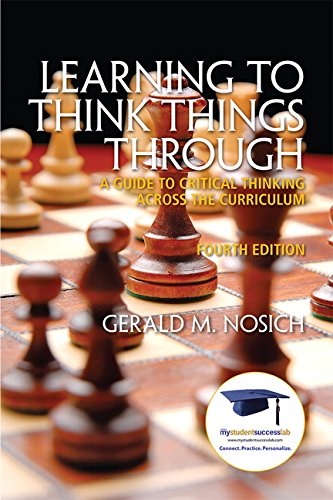
Learning to Think Things Through: A Guide to Critical Thinking Across the Curriculum (4th Edition), by Gerald M. Nosich

Download PDF Learning to Think Things Through: A Guide to Critical Thinking Across the Curriculum (4th Edition), by Gerald M. Nosich
Learning To Think Things Through: A Guide To Critical Thinking Across The Curriculum (4th Edition), By Gerald M. Nosich. One day, you will certainly find a brand-new adventure and also understanding by investing even more cash. But when? Do you believe that you need to get those all needs when having much cash? Why do not you attempt to get something basic initially? That's something that will lead you to understand more regarding the globe, journey, some places, past history, home entertainment, and also more? It is your very own time to proceed checking out behavior. One of the publications you could appreciate now is Learning To Think Things Through: A Guide To Critical Thinking Across The Curriculum (4th Edition), By Gerald M. Nosich here.
When visiting take the encounter or ideas kinds others, book Learning To Think Things Through: A Guide To Critical Thinking Across The Curriculum (4th Edition), By Gerald M. Nosich can be a great resource. It's true. You can read this Learning To Think Things Through: A Guide To Critical Thinking Across The Curriculum (4th Edition), By Gerald M. Nosich as the source that can be downloaded below. The means to download is additionally easy. You can see the link page that our company offer and then purchase guide making an offer. Download Learning To Think Things Through: A Guide To Critical Thinking Across The Curriculum (4th Edition), By Gerald M. Nosich and also you can deposit in your very own gadget.
Downloading and install the book Learning To Think Things Through: A Guide To Critical Thinking Across The Curriculum (4th Edition), By Gerald M. Nosich in this web site lists can give you more benefits. It will show you the very best book collections and completed compilations. Many books can be located in this site. So, this is not only this Learning To Think Things Through: A Guide To Critical Thinking Across The Curriculum (4th Edition), By Gerald M. Nosich Nonetheless, this book is referred to read because it is a motivating book to provide you more chance to get encounters as well as thoughts. This is simple, review the soft documents of the book Learning To Think Things Through: A Guide To Critical Thinking Across The Curriculum (4th Edition), By Gerald M. Nosich as well as you get it.
Your impression of this book Learning To Think Things Through: A Guide To Critical Thinking Across The Curriculum (4th Edition), By Gerald M. Nosich will certainly lead you to obtain what you precisely require. As one of the impressive publications, this publication will supply the visibility of this leaded Learning To Think Things Through: A Guide To Critical Thinking Across The Curriculum (4th Edition), By Gerald M. Nosich to accumulate. Even it is juts soft documents; it can be your collective data in gizmo and other device. The important is that usage this soft documents book Learning To Think Things Through: A Guide To Critical Thinking Across The Curriculum (4th Edition), By Gerald M. Nosich to read and take the advantages. It is exactly what we imply as book Learning To Think Things Through: A Guide To Critical Thinking Across The Curriculum (4th Edition), By Gerald M. Nosich will certainly improve your ideas and also mind. After that, reading publication will certainly likewise improve your life quality much better by taking great action in balanced.
For Freshman Orientation or Critical Thinking courses as well as a supplementary text for use in any subject-matter at any educational level. This concise, effective guide is designed to help students learn to think critically in any subject-matter.
Learning to Think Things Through presents a combination of instruction and exercises that shows the reader how to become active learners rather than passive recipients of information, use critical thinking to more fully appreciate the power of the discipline they are studying, to see its connections to other fields and to their day-to-day lives, and to maintain an overview of the field so they can see the parts in terms of the whole. The model of critical thinking (used throughout the book) is in terms of the elements of reasoning, standards, and critical thinking processes. This model is well-suited to thinking through any problem or question. The 4th edition reflects streamlined writing, with changes and substantial edits on virtually every page.
Personalize learning with MyStudentSuccessLab™
MyStudentSuccessLab is an online homework, tutorial, and assessment program designed to engage students and improve results. Within its structured environment, students practice what they learn, test their understanding, and pursue a plan that helps them better absorb course material and understand difficult concepts. It fosters the skills students need to succeed for ongoing personal and professional development. Whether face-to-face or online, MyStudentSuccessLab personalizes learning to help students build the skills they need through peer-led video interviews, interactive practice exercises, and activities that provide academic, life, and professionalism skills.
NOTE: This is the standalone book, if you want the book/access card order the ISBN below:
0134019466 / 9780134019468 Learning to Think Things Through: A Guide to Critical Thinking Across the Curriculum Plus NEW MyStudentSuccessLab Update -- Access Card Package
Package consists of:
0133939243 / 9780133939248 MyStudentSuccessLab -- Glue in Access Card
0133939251 / 9780133939255 MyStudentSuccessLab -- Inside Star Sticker
0137085141 / 9780137085149 Learning to Think Things Through: A Guide to Critical Thinking Across the Curriculum
- Sales Rank: #387052 in Books
- Published on: 2011-01-30
- Original language: English
- Number of items: 1
- Dimensions: 8.80" h x .60" w x 5.80" l, .62 pounds
- Binding: Paperback
- 256 pages
Review
"This text stacks op very well against its competition because it is concise. The difficulty in choosing texts on critical thinking is that they are either too complicated, do not offer enough coverage, or use a particular discipline to explicate critical thinking. What makes this text effective is that it is easy to work with and applicable to any and all disciplines."
- Susan Quarrell, Lehman College
From the Inside Flap
To the Instructor
This book is intended as a guidebook for learning to think critically in a discipline, a subject matter, an area, or a field of study. I use these terms more or less interchangeably throughout the book. It applies to disciplines taught at any level of generality, at any educational level. This includes courses in humanities, social and natural sciences, business, arts, nursing, international studies, and so on. It includes multidisciplinary courses, but it is in no way confined to them.
I specifically mean to include courses that emphasize doing as well as understanding: composition courses stand out in particular. (There are exercises suitable for student writing, and the text promotes full integration of the composition course with other courses students are taking, across the curriculum.) But the book applies to any discipline that emphasizes mindful doing: physical education, nursing, business, math, veterinary science, agriculture, foreign languages. (In fact, in the purest sense, all courses emphasize doing: learning physics is learning to do physics. Learning physics is learning how to actively think one's way through the physical world.)
Although this book was not written to be the main text in a course specifically in critical thinking, I have used it that way in my own courses, and many teachers of critical thinking have used Richard Paul's model in their courses.
In my critical-thinking courses, I have asked my students to use the model to analyze and evaluate newspaper editorials; to apply it to problems in their personal lives; to analyze their relationships with other people; to analyze, compare, and evaluate news sources and advertising; to evaluate their own study skills; to think through art works and a wide variety of other topics. Several times I have taught my critical-thinking course where the only other texts required were the .texts from other courses the student was taking. There, the goal was to help the students learn to think through the disciplines or subject matter they were studying in those other courses. What permits this diversity is the great flexibility of Paul's model of critical thinking.
This book is a guide to critical thinking across the curriculum and is intended to be inexpensive, so that it can be used economically as an adjunct text in a course. I have tried to keep it short enough so that students can be required to read it all the way through near the beginning of the semester. That way they can refer back to it again and again, applying specific critical-thinking concepts to different parts of the subject matter as the course moves along, gradually coming to integrate those parts. Learning to Think Things Through works best, I believe, when used in a course that has another text. In most cases, that will be the main required book for the course, but it needn't be. The "text" can consist of readings brought in by the teacher or by the students. It can be video or audio material of any sort. It can include chapters, specific problems, case studies, primary sources, journal articles, virtually any outside material. Many questions in this book direct students to apply critical-thinking concepts to the texts in the course.
Many teachers in a field or discipline want their students to learn to think critically about the subject matter they are studying, and to learn to think about the world in terms of that subject matter. They want their students not to be passive recipients of information absorbed from the teacher or the text. Rather, teachers want their students to become active learners who pay attention to crucial elements of reasoning, such as assumptions, purposes, implications and consequences, and who do this in a way that meets high intellectual standards. This book is intended to help accomplish those goals. Using Learning to Think Things Through in a Course
This book can be used by teachers in a range of ways. The way of using the text that I favor is as a highly integrated part of the course as a whole. The goal, again, is to keep students actively thinking their way through the course and the subject matter, rather than sinking back into being passive recipients.
As the teacher, I can have them identify key concepts of the discipline for each chapter, unit, lesson, lecture, and presentation. I can have them construct applications of the concepts from their own experience, integrate the concepts, and draw up concept maps. Students can be given frequent practice at formulating key questions, finding relevant information, evaluating its significance, and searching for alternatives. I can have the students analyze readings or important course material right from the beginning of the course.
In addition to giving students ongoing practice at thinking critically within the discipline, activities like these furnish the teacher with valuable insight into where exactly their students are in the course. These activities can be done in group work or individually, in class or as homework assignments, in written or oral form, with or without specific feedback from the teacher. Activities like these, and many others, are identified in Learning to Think Things Through, and there are exercises on such thinking activities at the end of each chapter.
There are any number of other ways this book can be used in courses. Teachers can have students work through the book on their own. Assigning exercises at the end of each chapter (some of which have suggested answers) can significantly help students in their critical thinking with minimal input from the instructor.
Many teachers find it valuable to devote some class time to helping students learn how to assess their own work and the work of fellow students, giving one another critical feedback on the thinking. The elements (Chapter 3) and standards (Chapter 4) are an ideal vehicle for this. Devoting this class time, even though it might seem at first glance to cut down on the amount of time devoted to teaching the discipline, allows teachers to give frequent short written assignments throughout the semester (shown to be highly effective in helping students retain and internalize the discipline) and to make sure students receive at least some feedback on them. It does this without increasing the amount of valuable time the teacher spends on reading and correcting student assignments. The brunt of learning is placed where it ought to be, as a responsibility of the students themselves. Teachers are freer to become the resource and the facilitator of learning that they really are.
The elements, standards, and subject-matter concepts make this task of self-assessment focused and beneficial both for the student being assessed and the student doing the assessing. Both are engaged in doing critical thinking about the subject matter. This book contains exercises specifically on this, and many more can be readily constructed using the elements and standards.
Consider a simple example. One of the elements is purpose, and one of the standards is clearness. In my courses, I give frequent written assignments. For each of them, I ask students to write down at the top what, in their best judgment, is the purpose of the assignment. This in and of itself helps students to focus their thinking (and to be aware that the assignments in fact have a purpose—that is sometimes a surprise!). Then I ask students, in pairs or in groups of four, to assess how clearly each statement of purpose was written. That gives students specific critical thinking feedback on an important standard, and the clarity of their responses almost invariably improves. Similar feedback can be given from student to student about any of the elements and any of the standards.
One further note on using Learning to Think Things Through: the model presented here is a highly integrated model, and there is great benefit in having students read the entire book near the beginning of the course, rather than piecing it out as the course progresses. The flexibility and comprehensiveness of the model are not as available to students when they learn one part at a time and then try to get a sense of the whole. After getting a sense of the whole, students can then work on those aspects that give them difficulty. The Model
This book is built on Richard Paul's model of critical thinking. I wrote Learning to Think Things Through because there is no short, connected presentation of this model suitable for use in a subject-matter course. Essential parts of it are set forth in Paul's Critical Thinking: What Every Person Needs to Survive in a Rapidly Changing World and in Critical Thinking: Basic Theory and Instructional Structures. The model is the one Paul, Linda Elder, 1, and a number of other workshop facilitators at the Center for Critical Thinking have used in workshops and academies over the years.
The model has quantitative empirical backing. Jennifer Reed, in her doctoral dissertation, tested Paul's model in history classes at the community college level. It fared well not just compared to a didactic course in history, but compared to an alternative model of critical thinking where the key concepts were taught implicitly rather than explicitly (with no significant differences in knowledge of history content).
Two parts of this model form the core of this book.
Elements of Reasoning. These are the central concepts of reasoning itself. Paul often describes them as the "parts" of thinking. When I reason through something, I may be trying to do any number of things: I may be trying to see the implications of holding a certain point of view, for example, or I may be trying to come to some conclusion, based on certain assumptions I start out with. I may be deciding that I need more information to decide this question at issue. I may simply wonder what my purpose is in a certain venture, and what alternatives there are. All of these, and many others, are examples of trying to reason through something. The elements of reasoning are an attempt to extract the common concepts from this virtually unlimited set of reasoning activities. Thus, to learn to reason is to come to mastery of concepts like implications, point of view, conclusions, assumptions, information, question at issue, and purpose. Concepts like these are elements of reasoning. Chapter 3 is devoted to the elements. Standards of Critical Thinking. It can be seriously misleading to say that critical thinking is learning how to think. Critical thinking is learning how to think well. It is thinking that meets high standards of quality. Again, there are many ways I can think through something well. I can figure out that one conclusion is more accurate than another. I can see implications more clearly than I saw them before. I can focus on the most important aspects of a problem. I can realize that I've thought through an issue sufficiently, and that now it is time to act. The standards are an attempt to formulate the heart of what constitutes the quality component in critical thinking. Like the elements, the standards are a set of concepts. I think through an issue well when I think it through accurately and clearly, when I focus on what is most important to deciding the issue, when I think it through sufficiently. To learn to reason well is to come to mastery not only of the elements, but also of standards like accuracy, clearness, importance, and sufficiency. Concepts like these are standards of critical thinking. Chapter 4 is devoted to the standards.
The general injunction, then, in Paul's model, is this:
Take any problem, in any area, and think it out using the elements of reasoning and the standards of reasoning.
Developing a greater ability to think in terms of the elements and standards promotes a flexibility that is ideally useful, and maximally transferable, in teaching for critical thinking in subject-matter courses across the curriculum.
In Learning to Think Things Through, both elements and standards are applied to thinking within the discipline. Part of this, in any field, is learning to think the way someone in that discipline thinks. That means being able to think in terms of specific systems that are taught in the discipline (Chapter 5). More than that, it means being able to think in terms of those central concepts and questions that lie at the heart of the discipline. These are described in Chapter 2.
My presentation of Paul's model differs from his in a few important respects. I have added context and alternatives to his eight elements. I have also omitted part of Paul's model. For example, because of space limitations, I have reluctantly omitted discussion of the extremely valuable intellectual traits, such as intellectual courage and intellectual humility. Putting It All Together
A general picture is presented in Chapter 5. It is a picture of the core process of critical thinking, of answering critical-thinking questions in the subject matter. It is tagged by the acronym QEDS. You begin by looking critically at the question being asked (Q). You think it through using the elements (E) and the central concepts and questions of the discipline (D). You assess and revise your thinking using the standards (S).
This core process, common to all areas of thinking, is what makes critical thinking transferable. By internalizing it in your course, students can learn to think more effectively in other courses, in the interconnections between disciplines, and in their lives as related to the disciplines. To the Student
The aim of this book is to help you improve your critical thinking within the subject matter of the courses you are taking. A secondary goal, a byproduct of the first, is to help you improve your ability to think effectively in your life as a whole. The way you use this book is likely to be different from the way you use most books in courses.
First, this isn't a book you can just read through. You can't get better at critical thinking merely by reading about critical thinking—not even if you're a very good reader. You have to do it. You have to take problems or questions the text asks and actually think them out as you work your way through the book. At least some of them: In addition, it helps if you can get feedback on your thinking. You have to do this again and again.
That's because what the book teaches is not a body of information. If the book is successful for you, you will be learning to do something. That requires more than just learning information, more than just learning skills. It is not just about how to think critically—it is about actually thinking critically.
Learning to do something cannot be accomplished just by reading about it. You can't get thinner merely by reading about dieting; your basketball or dancing won't improve merely by hearing about how to dance or shoot free throws. Your writing won't improve merely by learning that you have to consider your audience—you actually have to consider your audience. To improve the way you do something, it takes both instruction (in this case, reading the book, receiving feedback) and practice (doing it).
Second, depending on what your instructor says, you may need to read the book all the way through right near the beginning of the course, including doing the thinking work. That's because the book gives a unified overall model for critical thinking, and you have to see how the parts all fit together. In the model presented in this book, you think in terms of the subject you are studying (Chapter 2), the elements of reasoning (Chapter 3), the standards of reasoning (Chapter 4), and putting it all together (Chapter 5). You need to have a grasp of the whole model to think your way through questions in the discipline. In the end, the book promotes a different way of approaching the world—by thinking your way through it.
In some fields you proceed step-by-step, learning a skill well, and only then going on to the next skill (and hoping you don't forget the first one on the way). Critical thinking is different. A major goal of critical thinking is always to keep the whole in mind as you are working through the parts.
So, with this book, it is better to work all the way through to the end and get the big picture even if there are some glaring gaps in your understanding. (If you ponder it for a while, you'll realize that's the way you learned most complex skilled activities: you don't learn batting well and only then begin to learn catching; you don't learn how to shop for groceries by first getting good at writing down what you need, and only then going on to the skills of selecting a store, comparing prices, etc. Instead, you engage in the whole process from the beginning, gradually filling in gaps and improving.)
Third, Learning to Think Things Through is not a book that you can work through once and then be done with. Instead, you'll have to refer back to it whenever problems arise for you. After working all the way through it the first time, there will be glaring gaps in your understanding of various aspects of critical thinking. When you have trouble with assumptions, for example, you need to reread the section on assumptions in Chapter 3. But also look in the index under "assumptions" for other passages that may help. Do some of the exercises on assumptions, especially those that are starred (*) and have suggested answers in the back of the book. At the end of the course, some parts may still be unclear and confusing. Even if that's so, you can still use the model as a whole. It will still be practical: in the course you are taking, in other courses, and in decisions you have to make in your own life.
Fourth, this is a guide to thinking critically within the discipline you are studying: composition, geology, educational psychology, or business—any field or subject matter. Only a fraction, if any, of the examples in the text and exercises, however, will be from the discipline you are actually studying. It is vitally important that you work your way through them. They have been selected so as to convey critical thinking concepts across the curriculum, to all disciplines.
No technical knowledge is presumed in this book. Except for the discipline you are currently studying, you are not expected to know the specific field being discussed.
Critical thinking transfers. If you consciously learn critical-thinking techniques in one field, you may have those techniques available for another field. By the end you may find that your learning in your other courses becomes faster, more in your control, more lasting, and more beneficial for your life outside school.
Finally, in the end you will have to be the judge of whether using the model here improves your thinking. Certainly it won't be all or nothing. Critical thinking is a matter of degree. At the end of the course you should find yourself more often checking for accuracy, identifying assumptions, drawing relevant conclusions, thinking questions out in terms of the fundamental and powerful concepts of the discipline you are studying.
One way to think about the process is to imagine yourself in the hands of a good coach, a critical-thinking coach. This book is the manual the coach is asking you to follow, and the coach will give you feedback along the way.
Who is the coach? Well, in a way, it is your instructor. On a much deeper level, though, it is the healthy, thinking organism within you. In the end, you are going to accept processes and thinking guidelines only if they work for you. You will have to see them pay off—in your studies, in your grasp of the subject matter, in your understanding of your relations with other people—before you incorporate them into your life. But you first have to give them a chance to see if they do pay off. Acknowledgments
It is a pleasure to express my gratitude to Richard Paul. I told him I would "try on" his model for a year (1991-92). At the end of the year I found that it had transformed not just the way I taught critical thinking, but the way I thought about my life as well. My debt to Richard goes well beyond this book. Every time we meet I look forward to the vivid, focused intellectual conversations I have with him and Linda Elder. He has been my close friend for many years.
I am greatly indebted to any number of thinkers I have worked with and been close to: A. J. A. Broker, Mike Donn, Bill Dorman, Linda Elder, Bob Ennis, Edward Johnson, Ralph Johnson, Ann Kerwin, Marlys Witte; to those who also gave me their time and critical-thinking examples during the writing of this manuscript: Anne Buchanan, Francis Coolidge, Ines Eishen, Jerel Fontenot, Jennifer Reed, Ian Wright; to Jean Von Ah, who gave me help and encouragement at the beginning of this project; and to the students in my critical-thinking classes.
I want to thank the reviewers for their encouraging and invaluable commentary: Jean Chambers, SUNY-Oswego; Paul Grawe, Winona State University; Jim Pollard, Spokane Falls Community College; and Carolyn Vitek, St. Mary's University of Minnesota; and my editor at Prentice Hall: Sande Johnson.
Any inaccuracies or questionable assumptions in this book are my own.
For deep personal support, I want to thank not only Richard Paul, but also Ralph Johnson, Matthew Nosich, Andy McCaffrey, and the members of my I-Group, Spirit Group, and NOMC.
From the Back Cover
Learning to Think Things Through is a concise, effective guide is designed to help students learn to think critically in any subject-matter. A combination of instruction and exercises shows readers how to use critical thinking to become active learners rather than passive recipients of information, to more fully appreciate the power of the discipline they are studying, to see its connections to other fields and to their day-to-day lives, and to maintain an overview of the field so they can see the parts in terms of the whole. The model of critical thinking is in terms of the elements of reasoning, standards, and critical thinking processes, and is well-suited to thinking through any problem or question. The 4th edition reflects streamlined writing, with changes and substantial edits on virtually every page.
"This text stacks op very well against its competition because it is concise. The difficulty in choosing texts on critical thinking is that they are either too complicated, do not offer enough coverage, or use a particular discipline to explicate critical thinking. What makes this text effective is that it is easy to work with and applicable to any and all disciplines."
- Susan Quarrell, Lehman College
For more information about the book including its’ support package, go to www.pearsonhighered.com/studentsuccess
Start strong. Finish stronger.
www.MyStudentSuccessLab.com
Most helpful customer reviews
13 of 13 people found the following review helpful.
Great start!
By Radek
Shortly after I began reading, I got the feeling that this book is intended to either be a text book on its own, or a companion book in some other course. It gives a nice break down and step by step instruction on the basics of critical thinking.
Throughout the book, the author stresses that being a critical thinker is not the same as a fault finding mission. They intend for you to question the thoughts/ideas/arguments put forth by any writer or speaker. After that, investigate what was said/written and then decide for yourself what you believe. There are several exercises in there that concentrate on examining your own belief system. By doing this, it becomes clearer to the individual what they know about their own beliefs vs what they assume about thiers or others beliefs.
Very challenging. Very engaging. Do not read if you don't have the constitution to examine and challenge yourself.
0 of 0 people found the following review helpful.
Five Stars
By Amazon Customer
Needed this for a class. Just what was needed!
1 of 1 people found the following review helpful.
Great organization of how to think something through.
By Dave
One of the most useful books of my reading year. It's not a light read - but provides benefits if you put the work into it. The author structures a process of making a decision based on many factors. This is well worth having and reading. I've bought two copies so far to give to friends.
See all 23 customer reviews...
Learning to Think Things Through: A Guide to Critical Thinking Across the Curriculum (4th Edition), by Gerald M. Nosich PDF
Learning to Think Things Through: A Guide to Critical Thinking Across the Curriculum (4th Edition), by Gerald M. Nosich EPub
Learning to Think Things Through: A Guide to Critical Thinking Across the Curriculum (4th Edition), by Gerald M. Nosich Doc
Learning to Think Things Through: A Guide to Critical Thinking Across the Curriculum (4th Edition), by Gerald M. Nosich iBooks
Learning to Think Things Through: A Guide to Critical Thinking Across the Curriculum (4th Edition), by Gerald M. Nosich rtf
Learning to Think Things Through: A Guide to Critical Thinking Across the Curriculum (4th Edition), by Gerald M. Nosich Mobipocket
Learning to Think Things Through: A Guide to Critical Thinking Across the Curriculum (4th Edition), by Gerald M. Nosich Kindle
Learning to Think Things Through: A Guide to Critical Thinking Across the Curriculum (4th Edition), by Gerald M. Nosich PDF
Learning to Think Things Through: A Guide to Critical Thinking Across the Curriculum (4th Edition), by Gerald M. Nosich PDF
Learning to Think Things Through: A Guide to Critical Thinking Across the Curriculum (4th Edition), by Gerald M. Nosich PDF
Learning to Think Things Through: A Guide to Critical Thinking Across the Curriculum (4th Edition), by Gerald M. Nosich PDF


